be curious
Making handovers work
1 December 2025
Development is monitored and reviewed. Delivery is celebrated. However, one project phase remains systematically underprioritised: the handover.
In the lifecycle of IT projects, transitions in leadership, particularly the handover between project managers, pose a significant threat to continuity, knowledge retention, and stakeholder alignment. Despite this, most organisations treat handovers as informal, ad hoc events rather than what they truly are: complex, high-risk processes that demand structure and intention.
This paper argues that the current state of project handovers constitutes a blind spot in modern project governance. It also offers a practical framework for addressing this gap.
A handover is not a point in time – it is a process
In many organisations, handovers are reduced to a brief meeting, a few hastily written notes, or a shared document repository. This approach reflects an outdated understanding of project dynamics. Contemporary IT projects are characterised by complexity, rapid change, and deep interdependence between roles, systems, and stakeholders.
To treat handovers as isolated moments is to misunderstand the nature of the work itself. A project handover should be recognised as a carefully managed process. It has its own success criteria, resource needs, and potential risks.
To move beyond improvisation, we must reconceptualise the handover as a designed and facilitated transition.
Why this matters, particularly now
In an era of continuous transformation, projects have become the primary vehicle for executing strategy. As a result, every failed handover carries the risk of strategic failure. The organisational consequences are real. They include delivery delays, erosion of stakeholder trust, knowledge loss, and poor resource utilisation.
Handover events are inevitable. People leave, priorities shift, and teams evolve. What is not avoidable is the disruption that often follows.
Recognizing handovers as pivotal project events creates an opportunity to strengthen delivery and protect value. This means that with the right structures in place, transitions can provide clarity and renewed alignment rather than confusion and drift.
The shift framework: a structured approach to handovers
Inspired by practices in high-risk fields such as healthcare, where structured handovers are essential, this framework builds on the ISBAR principles. ISBAR is widely used in clinical settings, where effective handovers are critical to patient safety. With that foundation, this version is tailored to IT project environments.
The SHIFT framework provides a language for making the intangible concrete, offering structure where uncertainty often dominates.
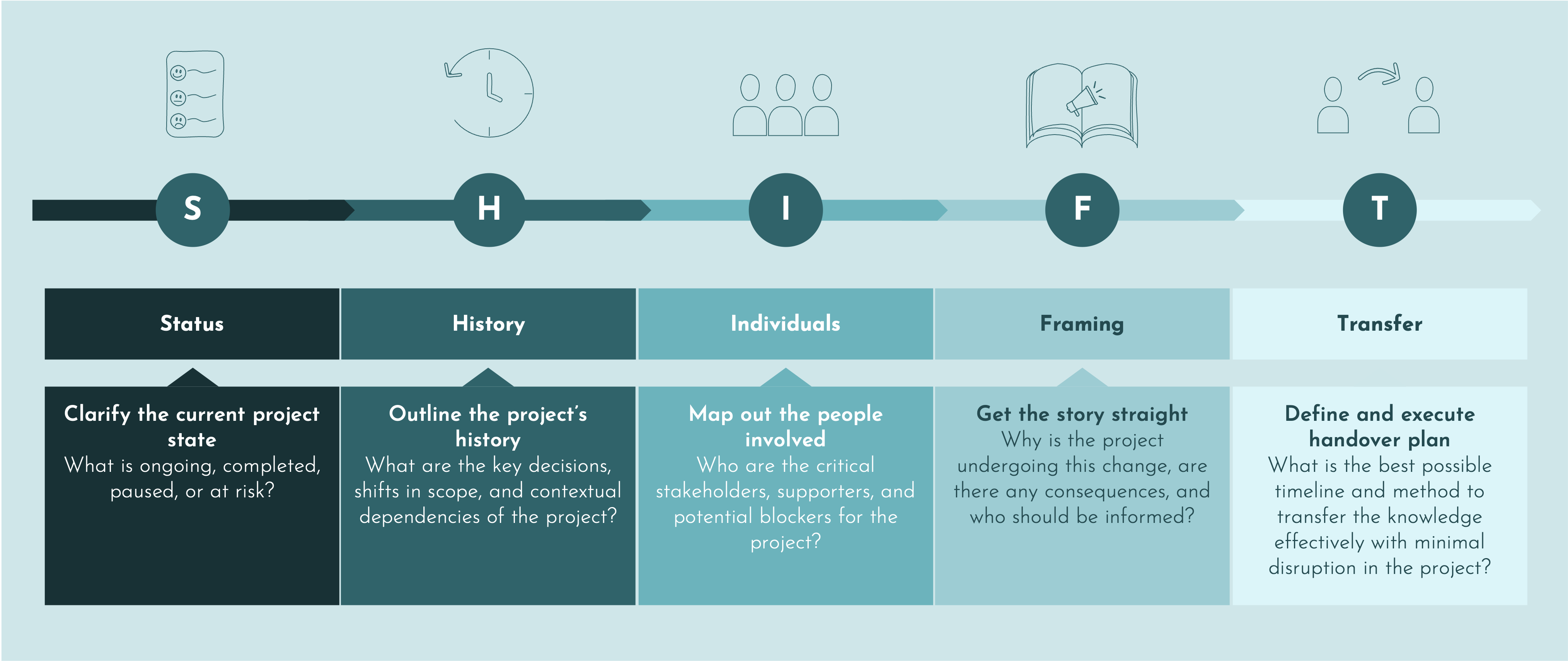
The framework identifies five essential components that must be addressed during any effective handover.
S — Status
Clarify the current project state. What is ongoing, completed, paused, or at risk? What are the immediate priorities and known issues?
H — History
Outline the project’s history, including key decisions, shifts in scope, and contextual dependencies. This enables the new lead to understand not only where the project is but also how it arrived there.
I — Individuals
Map out the people involved. Who are the critical stakeholders, supporters, and potential blockers? What are their expectations and current levels of engagement? Schedule a meeting to formally introduce the new project manager and clarify roles and expectations.
F — Framing
Plan for communicating the handover and its implications to the project team, key stakeholders, and the wider organisation. Define how continuity, direction, and expectations will be articulated to prevent uncertainty about project status, decision, and next steps.
T — Transfer
Define how the handover will be executed. Will it be gradual or immediate? What timeline and support structures are in place? Consider whether there will be an overlap period, shadowing sessions, or co-delivery of tasks to minimise disruption.
The framework is not intended as a rigid checklist. Rather, it provides a shared language and mindset for approaching handovers as integral parts of project execution.
From risk to resilience
Organisations that approach handovers as strategic moments rather than administrative tasks are better positioned to retain momentum, accelerate onboarding, and protect project value. A handover is not simply about transferring information. It is a transition of leadership, relationships, and accountability.
By embedding both the SHIFT framework and the underlying mindset into project culture, organisations are better equipped to mitigate ambiguity and sustain progress during personnel shifts.
The SHIFT framework provides the clarity and structure required to elevate this phase, as it enables teams to maintain continuity and move forward with purpose, even during change.
Moving forward
The message is simple: every handover needs a plan. Too many organisations invest heavily in launching and managing projects, only to leave them vulnerable during moments of transition.
By adopting a structured approach, the uncertainty of change can be transformed into a moment of intentional alignment.
Next time a project lead changes, ask not just who will take over; but whether the project is ready to be handed over at all. Consider whether the Status has been clarified, the History communicated, the relevant Individuals mapped, the Framing ensured, and the Transfer designed. If the answer is no, then the handover is not only incomplete; it is exposing the project to avoidable risk.
The SHIFT framework is what turns that risk into resilience – ensuring that what is handed over, is also carried forward.
Originally developed during a master’s thesis project, this paper has been adapted for a professional audience with a focus on practical application.

References
[A] Thye, N. H., & Clausen, A. J. (2024). The SBITC framework [Master’s thesis]. Copenhagen Business School.